Condition · varicose veins
Varicose vein treatment in Canberra
Varicose veins are enlarged leg veins that develop when the small valves inside them stop closing properly and blood pools instead of returning to the heart. In the Edinburgh Vein Study, about one in three adults aged 18 to 64 had varicose trunk veins. At Canberra Vein & Laser Medicine, treatment starts with a doctor-led assessment and a duplex ultrasound on site, so any plan is built around how your veins actually behave. Fees are published below, and a written plan quotes your exact figure.
What are varicose veins?
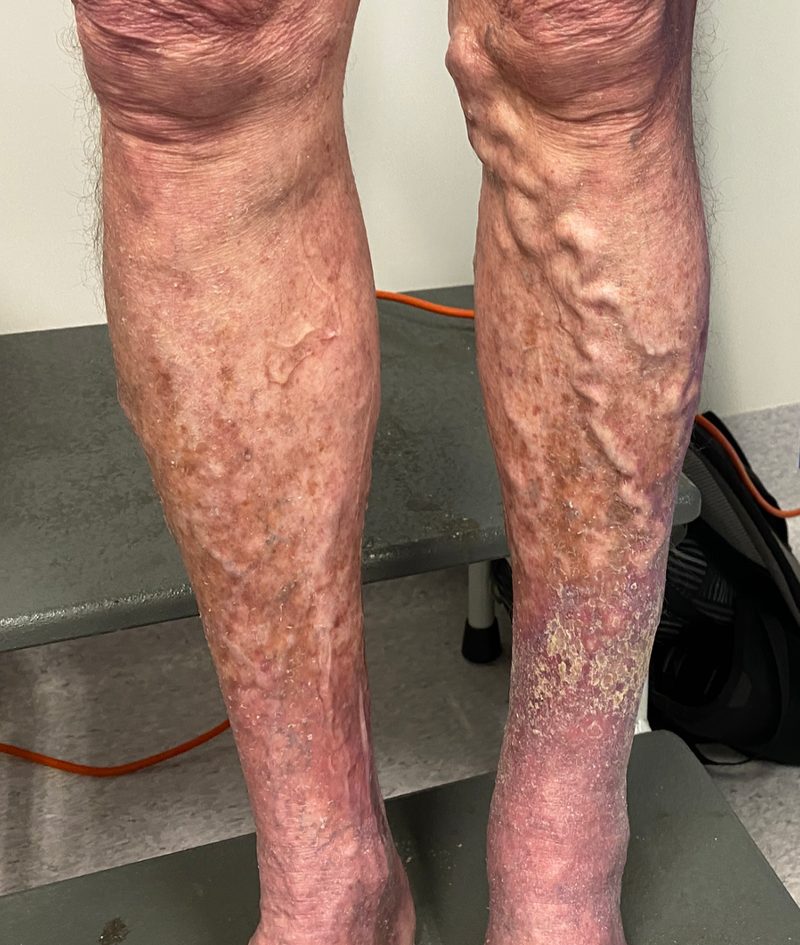
Varicose veins are surface veins in the leg that have stretched and become visible, often bulging or rope-like. They form when the one-way valves inside a vein stop closing properly. Instead of moving upward toward the heart, blood falls back down the leg with gravity and pools. Doctors call that reflux. Over time the pressure stretches the vein wall further, and the problem spreads to neighbouring veins.
What you see on the skin is usually the end of the story, not the beginning. The vein that is actually failing is often a deeper trunk vein you cannot see, and the visible varicose veins are branches fed by it. That is why treatment at CVLM is planned from a duplex ultrasound rather than from what the leg looks like.
Varicose veins sit within a wider group called chronic venous disease, which also includes reticular veins (flat blue-green veins) and spider veins. In the Edinburgh Vein Study, about one in three adults aged 18 to 64 had varicose trunk veins, and the proportion rose with age.
Cost and Medicare
Fees current as at September 2026. Fees are fixed per service; your written plan lists which services you need and the total before you decide anything. Where treatment is clinically indicated and eligibility criteria are met, the Medicare rebate leaves an out-of-pocket of $112.90 for the assessment, $2,657.10 or $2,355.00 per leg for EVLA depending on the veins treated, and $688.25 per session for ultrasound-guided sclerotherapy. The full breakdown is on the fees page.
| What | Fee |
|---|---|
| Initial vein assessment, including duplex ultrasound on site and a written plan | $200 |
| NeoLaser endovenous laser ablation (EVLA) | $3,200 one leg · $5,400 both legs |
| Ultrasound-guided sclerotherapy | $800 per session |
| Microsclerotherapy for spider veins | $800 per session |
A Medicare rebate applies where treatment is clinically indicated and eligibility criteria are met. Your assessment determines this before any treatment is planned. Clinically indicated generally means you have symptoms or skin changes and the ultrasound confirms the vein is refluxing. Treatment for appearance alone does not attract a rebate.
Procedures are performed in our rooms rather than in hospital, so hospital insurance cover does not usually apply. A pay-later option is available through Medipay. The fees page sets out the full schedule and what is included.
Signs and symptoms
Varicose veins do not always hurt, and the size of a vein is a poor guide to how much trouble it causes. Symptoms people describe include:
- aching or throbbing in the lower legs, worse at the end of the day or after standing
- a heavy, dragging or tired feeling
- swelling around the ankle
- itching over the vein or the skin around it
- restless legs, particularly in the evening, with an urge to keep moving them
- night cramps
- skin changes at the ankle: brown discolouration, dryness, eczema, or skin that feels hard and tight
- a sore near the ankle that is slow to heal
If you have had a clot in a leg vein, an episode of phlebitis, or a leg ulcer, the veins are worth assessing even without visible varicose veins.
What causes varicose veins
Vein valves fail for a mix of reasons. Family history is the strongest; if a parent had varicose veins, your chance is higher. Pregnancy, prolonged standing at work, increasing age and previous deep vein thrombosis all contribute. Being overweight raises pressure in the leg veins. None of these are things you did wrong, and crossing your legs does not cause them.
What happens if they are left untreated
Chronic venous disease usually progresses slowly. Many people live with varicose veins for years with little change. In others, the constant pressure damages the skin around the ankle: it darkens, becomes fragile and eczema-like, and in a minority breaks down into an ulcer that can take months to heal. Superficial clots in a varicose vein (phlebitis) are painful and occasionally extend into deeper veins. A knock to a varicose vein can bleed more than you would expect.
There is no rush to treat, and a cooling-off period of about a week separates your consultation from any treatment. The point of assessment is to know where you stand.
Who this is for
An assessment is worthwhile if you have visible varicose veins with any of the symptoms above, skin changes at the ankle, a history of leg ulcer or phlebitis, or leg swelling that has not been explained. It is also appropriate if your veins bother you and you want to know what is going on underneath before deciding whether to treat.
If your concern is spider veins with no other symptoms, the spider vein page describes the different pathway.
What happens at your appointment
Your first visit is a consultation with Dr Lapenga, not a treatment. It takes around 30 to 45 minutes. You will talk through your symptoms, history and what you want from treatment. Dr Lapenga examines your legs standing, then performs a duplex ultrasound in the same room. The scan maps which veins are refluxing, where the reflux starts, and whether your deep veins are healthy. There are no needles and no preparation is needed; wear or bring loose clothing.
Before you leave you will have the findings explained on the screen, a discussion of your options, and a written plan that sets out what is recommended, what it costs, and what the alternatives are, including doing nothing. No treatment is done on the day of your consultation.
Treatment options
Which treatment suits you depends on what the ultrasound shows, and often two are combined.
Endovenous laser ablation (EVLA) closes a refluxing trunk vein from the inside with a fine laser fibre under local anaesthetic. International guidelines, including the ESVS 2022 guidelines and NICE CG168, recommend endovenous thermal ablation as first-line treatment for a failing trunk vein. You walk in and walk out the same day.
Ultrasound-guided sclerotherapy treats veins that are too tortuous or too small for a laser fibre, and the branch veins left after EVLA. A prescribed sclerosant solution is injected under ultrasound guidance so the vein seals and is absorbed.
Microsclerotherapy treats surface spider veins with a very fine needle, usually after any underlying reflux has been dealt with.
Compression on its own eases symptoms for some people and is part of aftercare for every procedure.
All treatments are day procedures in our rooms. Most people return to normal activities the next day, and walking is encouraged from the moment you leave. Outcomes vary between people, treated veins can occasionally reopen, and new veins can develop over the years, so realistic expectations are part of every plan.
Who you will see
Dr Alex Lapenga is a Specialist General Practitioner with a fellowship of the College of Phlebology (UK). He performs the consultation, the duplex ultrasound and every treatment himself, so the person who scans your legs is the person who treats them. Canberra Vein & Laser Medicine is at The Woden Suites, Level 3, Francis Chambers, 40 Corinna Street, Phillip ACT 2606. Phone (02) 5119 3136.
FAQ
Questions people ask
- How much does varicose veins treatment cost?
- Varicose vein treatment at CVLM starts with an initial vein assessment ($200), which includes a duplex ultrasound on site and a written plan. Treatment fees depend on what the ultrasound shows: endovenous laser ablation $3,200 for one leg or $5,400 for both, ultrasound-guided sclerotherapy $800 per session. Your written plan quotes your exact figure before you decide anything. Fees current as at September 2026.
- How much does varicose veins laser treatment cost?
- Endovenous laser ablation (EVLA) at CVLM is $3,200 for one leg or $5,400 for both legs, as at September 2026. Sclerotherapy planned alongside it is $800 per session. A Medicare rebate applies where treatment is clinically indicated and eligibility criteria are met, which reduces your out-of-pocket. Your assessment determines this before anything is booked.
- How much does varicose vein removal cost?
- Modern varicose vein treatment closes the faulty vein rather than removing it surgically, so there is no hospital stay. Costs at CVLM are $800 per session for ultrasound-guided sclerotherapy and $3,200 for one leg or $5,400 for both legs for endovenous laser ablation, before any Medicare rebate. The full schedule, dated and explained, is on our fees page.
- Is varicose vein treatment covered by Medicare?
- A Medicare rebate applies where treatment is clinically indicated and eligibility criteria are met. In practice that means symptoms or skin changes plus duplex ultrasound findings that show the vein is failing. Treatment for appearance alone does not attract a rebate. Your assessment determines which applies to you before any treatment is planned.
- Do I need a referral for varicose veins?
- You can book an assessment at CVLM without a referral. A GP referral is welcome because it keeps your regular doctor in the loop and can support Medicare eligibility for some items. If you have one, bring it; if not, book anyway and we will write to your GP with your results if you would like us to.
- Are varicose veins dangerous?
- Most varicose veins are not dangerous, but they are usually a sign of chronic venous disease, which tends to progress slowly. Over years it can lead to swelling, skin discolouration, eczema and, in a minority, leg ulcers. Superficial clots (phlebitis) and bleeding from a vein can also occur. Assessment shows where you sit on that spectrum.